📋 Important Note
This guide is for general informational purposes only and is not legal advice. Estate planning laws vary by state. For complex estates, blended families, significant assets, or business interests, consult a licensed estate planning attorney in your state.
📋 What's Covered in This Guide
1. Why Estate Planning Matters Now
Retirement is the most important time to have your estate planning documents in order. Health decisions become more complex, asset transfers more significant, and the consequences of having no plan in place fall entirely on your family.[1]
What Happens Without an Estate Plan
- State intestacy laws decide who inherits your assets — not you
- Your estate goes through probate — a public, time-consuming, costly court process
- No one has legal authority to make medical decisions if you're incapacitated
- No one has legal authority to manage your finances if you're incapacitated
- Family disputes over assets become far more likely
- Your wishes for end-of-life care are unknown and legally unenforceable
2. The 5 Documents Every Retiree Needs
Estate planning doesn't require a complex trust structure or significant wealth. These five documents cover the most important bases for the vast majority of retirees.[2]
| Document | What It Does | When It Applies |
|---|---|---|
| Last Will & Testament | Directs how your assets are distributed after death | After you pass away |
| Durable Power of Attorney | Names someone to manage your finances if incapacitated | While you're alive but unable to act |
| Healthcare POA / Proxy | Names someone to make medical decisions for you | While you're alive but unable to decide |
| Living Will / Advance Directive | States your wishes for end-of-life medical care | When you cannot communicate your wishes |
| Revocable Living Trust | Transfers assets to heirs without probate | After you pass away — avoids court |
Two Ways to Create Your Documents Online
Both are far less expensive than hiring an attorney. Which fits depends on whether you want a complete estate-planning package or a single document fast.
Trusted estate-planning software since 1971
Best for a complete plan you buy once
- 35+ estate-planning documents in one package
- Will, living trust, power of attorney & health directive
- One-time purchase — no subscription
- Attorney-quality forms, valid in your state
- Works on your own computer for privacy
150+ legal documents, established 2001
Best for a single document, fast
- Create one document in minutes
- State-specific wills, POAs & more
- Free trial available
- Pay-as-you-go or membership options
- Good for a quick, focused need
⚖️ RetireCalm™ may earn a commission if you purchase through these links — at no extra cost to you. We only recommend tools we believe offer real value.
3. Last Will & Testament
A will is the foundation of any estate plan. It names who receives your assets, who manages your estate (executor), and if applicable, who cares for minor dependents. Without a will, your state's intestacy laws decide — and they may not align with your wishes.
📄 Last Will & Testament
A legally binding document that specifies how you want your property distributed after death, names an executor to carry out your wishes, and can designate guardians for minor children or dependents.
- Names beneficiaries for specific assets — home, bank accounts, personal property
- Designates an executor — the person responsible for carrying out your wishes
- Can specify funeral and burial preferences
- Must be signed and witnessed according to your state's requirements
- Does NOT avoid probate — but provides clear direction through the process
- Should be updated after major life events — marriage, divorce, death of a beneficiary
4. Power of Attorney
A Power of Attorney (POA) grants another person legal authority to act on your behalf. For retirees, two types are essential — financial and healthcare.[3]
📄 Durable Power of Attorney — Financial
Authorizes a trusted person (your "agent") to manage your financial affairs if you become incapacitated — paying bills, managing investments, filing taxes, handling real estate transactions.
- "Durable" means it remains in effect even if you become mentally incapacitated
- Takes effect immediately unless specified as "springing" (activates only upon incapacity)
- Without this document, your family may need court-appointed guardianship — expensive and time-consuming
- Choose your agent carefully — this is significant legal authority
📄 Healthcare Power of Attorney / Medical Proxy
Names a person to make medical decisions on your behalf if you are unable to communicate or make decisions yourself. This is separate from a Living Will — the POA names a person, the Living Will states your wishes.
- Your healthcare agent can consent to or refuse treatment on your behalf
- Choose someone who knows your values and will advocate for your wishes
- Should be someone geographically accessible in an emergency
- Discuss your wishes with this person in detail — don't just hand them the document
5. Living Will & Advance Directive
A Living Will — also called an Advance Directive or Advance Healthcare Directive — is a written statement of your wishes regarding medical treatment if you become unable to communicate. It guides your doctors and healthcare agent when facing end-of-life decisions.[4]
📄 Living Will / Advance Directive
Specifies which life-sustaining treatments you do or do not want if you are terminally ill, permanently unconscious, or in an end-stage condition and cannot speak for yourself.
- Addresses artificial nutrition and hydration, mechanical ventilation, resuscitation (DNR/DNI)
- Can specify preferences for pain management and comfort care
- Reduces the burden on family members facing impossible decisions without guidance
- Requirements vary by state — must comply with your state's specific rules to be valid
- Provide copies to your doctor, hospital, healthcare agent, and keep one accessible at home
Don't wait for a health crisis: Living wills are most valuable when created while you're healthy and clear-headed. A health scare is not the time to be drafting these documents for the first time.
6. Living Trust
A Revocable Living Trust is a legal arrangement where you transfer ownership of your assets to a trust during your lifetime — while retaining full control. At death, assets pass directly to your beneficiaries without going through probate court.[2]
| Feature | Will Only | Living Trust |
|---|---|---|
| Probate | Goes through probate | Avoids probate entirely |
| Privacy | Public record | Private — not public record |
| Speed of transfer | Months to years | Weeks — no court involved |
| Cost at death | Probate fees 3–8% of estate | Minimal — no court costs |
| Incapacity planning | No protection | Successor trustee takes over seamlessly |
| Upfront cost | Lower | Higher — but saves more at death |
| Best for | Simpler estates | Homeowners, multiple assets, privacy concerns |
📄 Revocable Living Trust
You are both the grantor (creator) and trustee (manager) during your lifetime. You maintain complete control and can modify or revoke the trust at any time. At death, a successor trustee distributes assets according to your instructions — no court required.
- Assets must be formally "funded" into the trust — titled in the trust's name
- A "pour-over will" should accompany the trust to catch any assets not transferred
- Does not provide asset protection from creditors — that requires an irrevocable trust
- Particularly valuable for homeowners in states with expensive or lengthy probate
7. Real Estate Documents
For retirees who own property, having the right real estate documents in order is an important part of estate planning — especially for property transfers, rental agreements, or deed changes.
📄 Quitclaim Deed
Transfers your ownership interest in a property to another person — commonly used to add a spouse to a deed, transfer property into a trust, or transfer property between family members.
- Does not guarantee clear title — used when parties know each other
- Common for transferring property into a living trust
- Must be notarized and recorded with your county recorder's office
8. Financial Documents
Beyond estate planning documents, retirees may need financial documents for loans between family members, promissory notes, or other financial arrangements.
📄 Promissory Note
A legally binding written promise to repay a loan — commonly used when lending money to family members. Protects both parties and establishes clear repayment terms.
- Specifies loan amount, interest rate, and repayment schedule
- Important if you lend money to children or family — protects the relationship and your estate
- Required by IRS for family loans above the Applicable Federal Rate threshold
9. Estate Planning Checklist
Use this checklist to assess where you stand and what still needs to be done.
- Last Will & Testament — created and signed with proper witnesses
- Durable Power of Attorney (Financial) — executed and agent informed
- Healthcare Power of Attorney — executed and agent informed
- Living Will / Advance Directive — completed per your state's requirements
- Beneficiary designations reviewed — IRA, 401k, life insurance, bank accounts
- Living Trust created if appropriate — and assets funded into the trust
- Property deeds reviewed — titled correctly or transferred to trust
- Digital asset instructions — passwords, online accounts, social media
- Important documents organized — originals stored safely, copies accessible
- Family informed — key people know where documents are and what your wishes are
- Documents reviewed every 3–5 years or after major life changes
Where to Store Your Documents
- Originals: Fireproof safe at home or safe deposit box at bank
- Copies: With your executor, healthcare agent, and attorney if applicable
- Living Will: Copy with your primary care doctor and any specialists
- Digital backup: Scanned copies in secure cloud storage
- Tell people where they are: Documents no one can find are documents that don't exist
10. Trusted Resources
👴AARP — Estate Planning Checklist→ 🏛️NIH — Getting Your Affairs in Order→ 🏛️CFPB — Managing Someone Else's Money→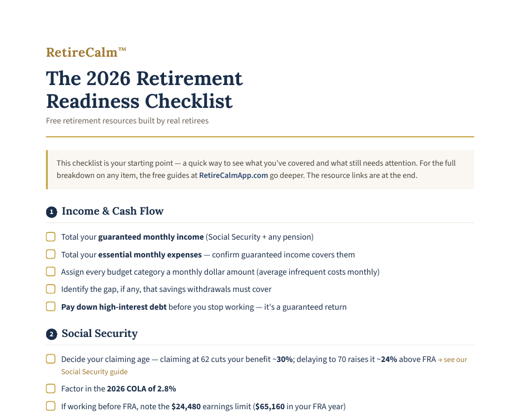
Don't miss a step — get the full 2026 checklist
A printable, all-in-one retirement readiness checklist with the verified 2026 numbers. Free.
Sources
- AARP Public Policy Institute. aarp.org
- American Bar Association. americanbar.org
- CFPB. consumerfinance.gov
- NIH National Institute on Aging. nia.nih.gov
Sources point to the authoritative organization for each claim. Medical and financial details change — confirm current specifics with the source or a professional.