🛡️ What's Covered in This Guide
1. How Social Security Works
Social Security retirement benefits are based on your earnings history — specifically your highest 35 years of indexed earnings. The SSA calculates your Primary Insurance Amount (PIA), which is the monthly benefit you'd receive at your Full Retirement Age.[1]
Check your earnings record: Errors in your SSA earnings record can reduce your benefit. Create a free My Social Security account at SSA.gov to review your earnings history and get a personalized benefit estimate. Corrections are easier to make before you claim.
2. Full Retirement Age & Claiming Windows
Your Full Retirement Age (FRA) is the age at which you receive 100% of your calculated benefit. It is determined by your birth year.[2]
| Birth Year | Full Retirement Age |
|---|---|
| 1943–1954 | 66 |
| 1955 | 66 and 2 months |
| 1956 | 66 and 4 months |
| 1957 | 66 and 6 months |
| 1958 | 66 and 8 months |
| 1959 | 66 and 10 months |
| 1960 and later | 67 |
Your Claiming Window
Age 62 — Earliest Possible Claiming Age
You can claim as early as 62 but your benefit is permanently reduced — up to 30% less than your FRA benefit if your FRA is 67.[3]
Age 66–67 — Full Retirement Age
You receive 100% of your calculated benefit. No reduction, no bonus.
Age 67–70 — Delayed Retirement Credits
Each year you delay past FRA adds 8% to your benefit — permanently. Delaying from 67 to 70 increases your benefit by 24%.[4]
Age 70 — Maximum Benefit
There is no additional benefit to delaying past 70.[4] This is the latest age that makes financial sense to wait.
3. When to Claim — The Decision
There is no universally correct answer. The best claiming age depends on your health, finances, longevity expectations, spouse's situation, and whether you're still working. Here is a balanced overview of the considerations.
Reasons to Claim Early (Age 62–64)
- You need the income now — health costs, gap in employment, or insufficient savings
- You have a serious health condition or family history of shorter longevity
- You are single with no survivor benefit considerations
- Average US life expectancy is approximately 77–78 — statistically, early claiming produces more lifetime income if you don't outlive the break-even age[12]
- You can invest early benefits and potentially outperform the delayed credits
Reasons to Delay (Age 67–70)
- You are in good health with family history of longevity
- You have other income sources to bridge the gap (pension, IRA withdrawals, part-time work)
- You are married — delaying maximizes the survivor benefit for your spouse
- Each year of delay past FRA adds 8% — guaranteed, inflation-adjusted growth[4]
- You want longevity insurance — protection against outliving your savings
- Your benefit will also be higher for Medicare IRMAA calculations
The Middle Ground — Claiming at FRA
- You receive your full calculated benefit with no reduction or bonus
- Avoids the complexity of delayed credits while eliminating the early claiming penalty
- A reasonable choice if you're unsure — you don't leave money on the table either way
Married couples: The higher earner delaying to 70 is often the most impactful strategy — it maximizes the survivor benefit that will support the remaining spouse potentially for decades. This consideration frequently outweighs individual break-even calculations.
4. Break-Even Analysis
The break-even age is when the total lifetime benefits from delaying equals the total from claiming early. After the break-even point, the higher benefit pays more for every remaining year.[13]
| Comparison | Approximate Break-Even Age | What It Means |
|---|---|---|
| Claim at 62 vs. FRA (67) | Approximately 78–79 | If you live past 79, waiting until 67 pays more total |
| Claim at 62 vs. Age 70 | Approximately 82–84 | If you live past 83, waiting until 70 pays more total |
| Claim at FRA (67) vs. Age 70 | Approximately 82–83 | The 24% higher benefit takes about 12–13 years to recoup |
Social Security Break-Even Calculator
Enter your actual benefit amounts from your SSA statement at ssa.gov. All three amounts are needed for accurate results.
5. Spousal Benefits
If you are married, divorced, or widowed, you may be eligible for benefits based on your spouse's earnings record — not just your own.[9]
Spousal Benefit Basics
Key Rules for Spousal Benefits[9]
- You can receive up to 50% of your spouse's FRA benefit — if that's higher than your own benefit
- Your spouse must already be collecting their own benefit before you can claim spousal benefits
- You must be at least 62 to claim spousal benefits (or any age if caring for a qualifying child)
- Claiming spousal benefits before your own FRA results in a permanently reduced spousal benefit
- Delayed credits do NOT apply to spousal benefits — there is no advantage to waiting past your FRA for the spousal benefit
- SSA pays the higher of your own benefit or the spousal benefit — not both combined
Divorced Spouse Benefits
You May Qualify Even After Divorce[9]
- Your marriage lasted at least 10 years
- You are currently unmarried
- You are at least 62
- Your ex-spouse is entitled to Social Security benefits
- Your own benefit is less than 50% of your ex-spouse's FRA benefit
- Your ex-spouse does NOT need to have filed — if divorced for 2+ years, you can claim independently
6. Survivor Benefits
When a Social Security recipient dies, their surviving spouse may be eligible for survivor benefits — which can be significantly higher than their own benefit. This is one of the most important and least understood aspects of Social Security planning.[10]
Key Survivor Benefit Rules[10]
- A surviving spouse can receive up to 100% of the deceased spouse's benefit — including any delayed credits earned
- Survivor benefits can be claimed as early as age 60 (50 if disabled)
- If you claim survivor benefits before your own FRA, the benefit is reduced
- You can switch from survivor benefits to your own benefit (or vice versa) — allowing a strategy of claiming one early while letting the other grow
- The higher earner delaying to 70 directly increases the survivor benefit — this is a critical planning consideration for married couples
Why this matters for married couples: If the higher earner dies first, the surviving spouse receives their benefit for potentially 20+ years. Maximizing that benefit by delaying to 70 can mean tens of thousands of dollars more in lifetime income for the survivor.
7. Social Security & Taxes
Depending on your total income, up to 85% of your Social Security benefits may be subject to federal income tax. Many retirees are surprised by this.[11]
| Combined Income* | Filing Single | Filing Jointly | % of SS Benefit Taxable |
|---|---|---|---|
| Below threshold | Below $25,000 | Below $32,000 | 0% |
| Moderate income | $25,000–$34,000 | $32,000–$44,000 | Up to 50% |
| Higher income | Above $34,000 | Above $44,000 | Up to 85% |
*Combined income = Adjusted Gross Income + nontaxable interest + ½ of Social Security benefits[11]
State Taxes on Social Security
Most states do not tax Social Security benefits. As of 2026, approximately 9 states tax Social Security to some degree[5] — a small and shrinking number that changes most years. New Jersey does not tax Social Security benefits. Always verify your state's current rules with your tax advisor.
Roth conversion strategy: If you delay Social Security and draw from traditional IRA funds in the gap years, consider Roth conversions during that lower-income window. This can reduce future RMDs and the portion of SS benefits subject to tax. Discuss with a tax advisor.
8. Cost-of-Living Adjustments (COLA)
Social Security benefits are adjusted annually for inflation through Cost-of-Living Adjustments. COLA is based on the Consumer Price Index for Urban Wage Earners and Clerical Workers (CPI-W).[6]
Recent COLA History[7]
- 2022: 5.9% — highest in 40 years at the time
- 2023: 8.7% — highest since 1981
- 2024: 3.2%
- 2025: 2.5%
- 2026: 2.8% (confirmed — Source: SSA.gov, October 24, 2025)
COLA applies to whatever benefit you are receiving at the time of the adjustment — meaning a higher base benefit from delaying results in larger dollar increases with each COLA. This compounds over time and is an additional argument for delaying if longevity is a consideration.
9. Working While Collecting
You can work while receiving Social Security — but if you claim before Full Retirement Age, your benefits may be temporarily reduced if your earnings exceed certain limits.[8]
| Situation | 2026 Earnings Limit | Reduction |
|---|---|---|
| Under FRA for the full year | $24,480/year | $1 withheld for every $2 over the limit |
| Reaching FRA during the year | $65,160/year | $1 withheld for every $3 over the limit |
| At or past Full Retirement Age | No limit | No reduction — earn as much as you want |
Important: Benefits withheld due to earnings are not lost permanently. Once you reach FRA, SSA recalculates your benefit to credit the months benefits were withheld — resulting in a slightly higher monthly payment going forward.[8]
10. Official Resources
Always verify Social Security information directly with the SSA. These are the most useful official tools.
👤My Social Security Account — View Your Earnings & Benefit Estimate→ 🏛️SSA.gov — Retirement Benefits Overview→ 🧮SSA Quick Calculator — Estimate Your Benefit→ 📋SSA — When to Start Receiving Retirement Benefits→ 🛡️SSA — Survivors Benefits→ 📄IRS Publication 915 — Social Security & Equivalent Railroad Retirement Benefits→Common Questions
When should I claim Social Security?
There's no universal right age — it depends on your health, savings, and whether you're still working. Claiming at 62 gives smaller checks for life; waiting until 70 grows them substantially. If you expect a long retirement and can cover the gap, waiting usually pays more over time. If not, claiming earlier may fit better.
How much more do I get by waiting until 70?
Quite a bit. Your benefit grows roughly 8% for each year you delay past full retirement age, up to age 70. Someone whose full benefit is $2,000 at 67 would get about $2,480 at 70 — and that higher amount, plus future cost-of-living increases, is locked in for life.
Can I work while collecting Social Security?
Yes, but before your full retirement age, earning above an annual limit temporarily reduces your benefit. Once you reach full retirement age, you can earn any amount with no reduction — and the earlier withholding is credited back into higher future checks. After full retirement age, working never lowers your Social Security.
Will my Social Security be taxed?
Possibly. Whether your benefits are taxed depends on your combined income. Higher total income means up to 85% of your benefits can be subject to federal income tax; lower income may mean none is taxed. Many states don't tax Social Security at all.
Can I claim benefits on my spouse's record?
Yes. A spousal benefit can be up to 50% of your husband's or wife's full benefit, which helps if your own earnings record is lower. You generally must be at least 62, and your spouse must have filed. Survivor benefits work differently and can equal up to 100% of a deceased spouse's benefit.
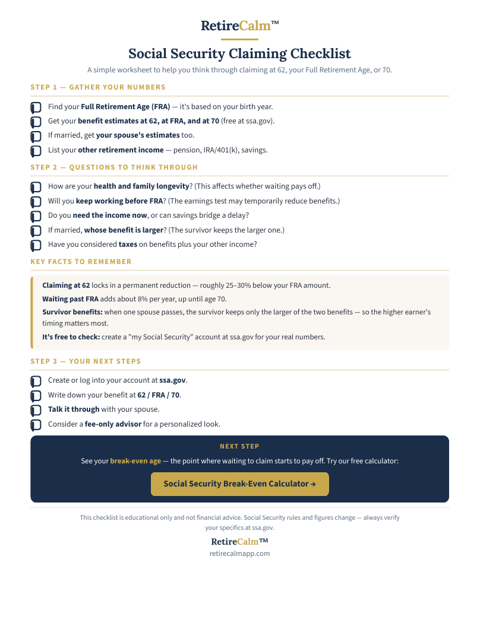
Get the free Social Security Claiming Checklist
A printable one-page worksheet to think through claiming at 62, your Full Retirement Age, or 70 — what to gather, the questions that matter, and your next steps.
Sources
- U.S. Social Security Administration — How Social Security retirement benefits are calculated (PIA). ssa.gov
- U.S. Social Security Administration — Full Retirement Age by birth year. ssa.gov
- U.S. Social Security Administration — Effect of claiming before Full Retirement Age. ssa.gov
- U.S. Social Security Administration — Delayed Retirement Credits (8% per year to age 70). ssa.gov
- State taxation of Social Security — note: the number of states changes yearly. aarp.org
- U.S. Social Security Administration — Cost-of-Living Adjustment (COLA) and the CPI-W. ssa.gov
- U.S. Social Security Administration — Historical COLA percentages. ssa.gov
- U.S. Social Security Administration — Receiving benefits while working / earnings limits. ssa.gov
- U.S. Social Security Administration — Family (spousal) benefits. ssa.gov
- U.S. Social Security Administration — Survivor benefits. ssa.gov
- U.S. Internal Revenue Service — Taxation of Social Security benefits (Publication 915). irs.gov
- U.S. Centers for Disease Control and Prevention — Life expectancy data (National Center for Health Statistics). cdc.gov
- U.S. Social Security Administration — Retirement benefit estimator / calculators. ssa.gov
Figures verified against official Social Security Administration publications. Federal and state tax rules change yearly — confirm current numbers before making decisions.